
Ask three Toronto production companies what a brand film costs and you will get three different answers, all of them technically correct and none of them useful. Most start at "it depends." Most end at "let's get on a call." Somewhere in the middle, the actual numbers stay vague enough that nobody can pin them down.
That is a problem. Buyers commissioning a brand film for the first time, or scaling up from a one-off video to something cinematic, deserve actual numbers. They deserve to know what sits inside those numbers, what is being quietly excluded, and what a serious quote should look like. Most production studios will not tell them.
Most brand films in Toronto land between $10,000 and $80,000 CAD in 2026. There are three clear tiers inside that range, and the difference between them is not equipment. It is crew, talent, pre-production, and the polish of the post. This is the full breakdown.

Last updated: May 17, 2026
The Quick Answer
A professional brand film in Toronto costs between $10,000 and $80,000 CAD in 2026. Most engagements fall into three tiers:
Entry-level brand films: $10,000 to $25,000 CAD. One shoot day, lean crew, single focused deliverable.
Mid-range brand films: $25,000 to $50,000 CAD. Two-day production, full crew, professional talent, polished post-production.
Premium brand films: $50,000 to $80,000+ CAD. Multi-day, multi-location, cinematic production with full creative direction and motion design.
The number a business lands on depends on scope, talent, locations, and post-production complexity. It rarely depends on equipment. Anyone telling you it does is selling you the wrong thing.
Why "Brand Film" Doesn't Mean One Thing
Before any of these numbers make sense, the term needs clarifying. A lot of the price confusion in this market comes from buyers and producers using the same word for very different products.
A brand film is a cinematic, narrative-led piece, usually 60 seconds to three minutes long, built around emotion and positioning rather than product features. It lives on a homepage, an investor deck, a recruitment page, a major campaign launch, or a partnership pitch. It is meant to be watched, not skipped.
A corporate video is informational. Training material, company overviews, internal communications, executive messages. These are functional pieces. They can be polished, but they are not designed to move a viewer emotionally.
A commercial is built for broadcast or paid placement. Usually 15 to 60 seconds. The structure is different, the pacing is different, and the post-production demands are different.
A product video focuses on a specific offering and walks through its features or benefits. Useful, but not the same animal.
A testimonial is interview-driven content. Lean crew, simple set, fast turnaround.
These five categories often share equipment and crew but carry wildly different price tags because of how much pre-production, talent, post-production, and creative direction sits behind each one. Throughout this article, when we say brand film, we mean the first one. The cinematic, narrative-led piece. That is also where most of the budget questions concentrate.
The Three Tiers of Brand Film Production in Toronto
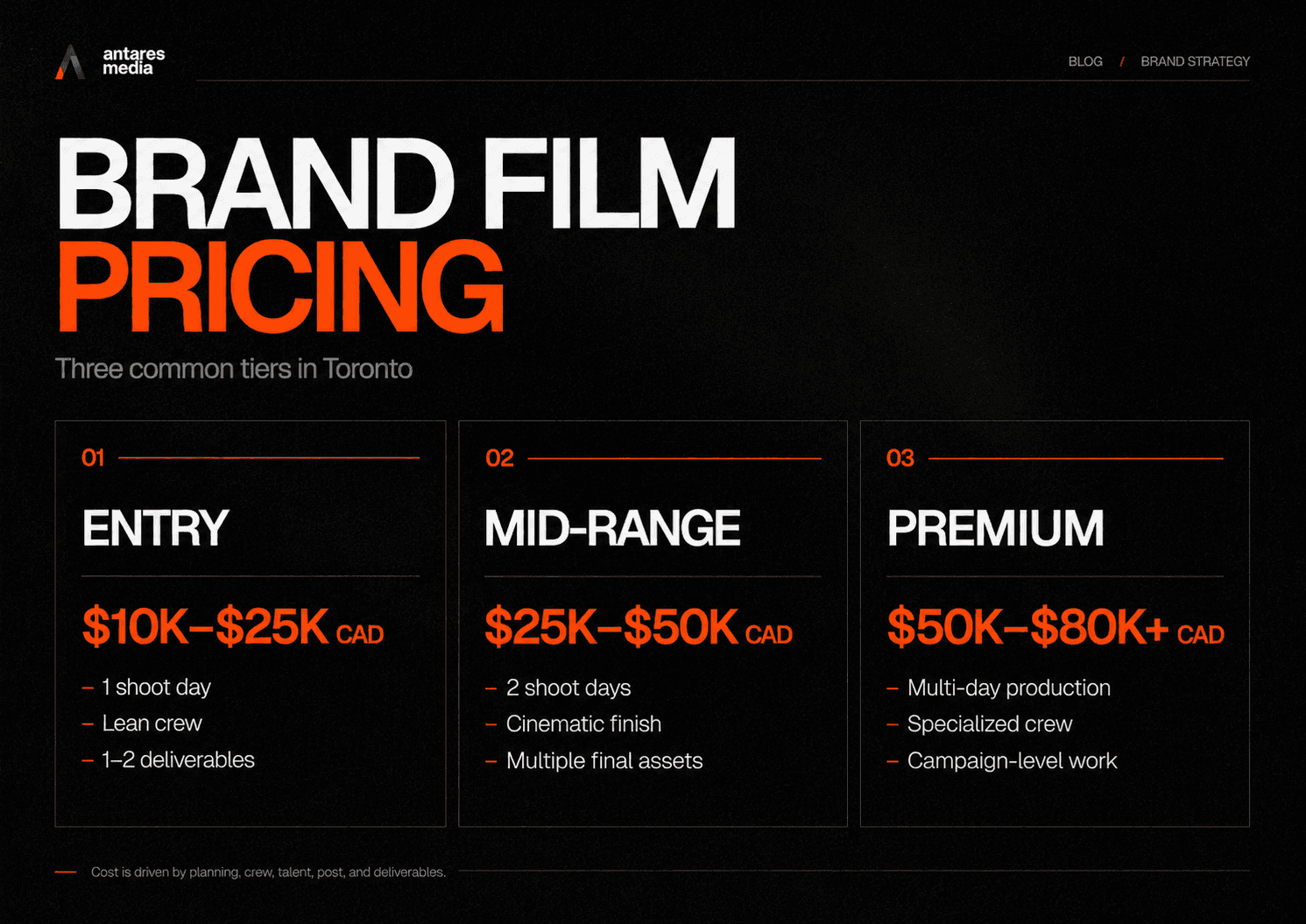
Most brand film engagements in the Toronto market fall into one of three tiers. Each tier solves a different business problem, and each carries a different set of trade-offs. Understanding which tier matches the goal is the first decision a buyer needs to make. The pricing question follows from that.
Tier One: Entry-Level Brand Films ($10,000 to $25,000 CAD)
This tier is for businesses commissioning their first serious piece of brand content. The format is focused. One shoot day. A lean professional crew of three to five people including a director, a cinematographer, sound, and a producer. One or two locations. Limited or no professional talent. Standard motion graphics. One to two deliverables, usually a 60 to 90 second hero cut and a small number of social cutdowns.
The work at this tier looks and feels professional. The pieces that come out of it can run on a website hero, on LinkedIn, or as a campaign opener. What this tier does not buy is cinematic scope, complex narrative, multi-location storytelling, or the kind of post-production craft that holds up on a paid placement against premium brands.
Businesses at this tier are usually founder-led companies, mid-market B2B firms, or established brands testing video as a channel for the first time. The investment is real, but the scope is contained.
Tier Two: Mid-Range Brand Films ($25,000 to $50,000 CAD)
This is the tier most established brands land in. It is also where the work starts to look genuinely cinematic.
A two-day production. A full professional crew of six to eight specialists including a director, a director of photography, dedicated sound, a gaffer, a producer, and one or two assistants depending on the shoot. Multiple locations. Professional talent on camera, sometimes coached for delivery. Motion graphics designed specifically for the piece rather than templated. Original music or properly licensed music. Professional color grading. Three to four revision rounds. Multiple deliverable formats including a hero cut, social cutdowns, vertical formats for stories and reels, and often a longer narrative version for internal use or partnership pitches.
The output at this tier is the version of brand film most businesses imagine when they start the process. It holds up on paid placements. It works in investor settings. It earns reuse across channels. The cost per channel drops sharply because the same shoot produces five to ten finished assets.
Businesses commissioning at this tier are usually marketing-led with a clear strategic objective: a brand repositioning, a major campaign launch, a recruitment push, a Series B or later raise.
Tier Three: Premium Brand Films ($50,000 to $80,000+ CAD)
The premium tier is built for ambition. Multi-day production, often three to five days, sometimes across multiple cities. Larger crews including specialized roles like art direction, casting, wardrobe, hair and makeup, and dedicated post-production supervision. Full creative direction from concept through delivery. Original score or premium music licensing. Cinema-grade equipment including specialized lenses, gimbal and crane work, aerial cinematography, and occasionally underwater or other technical setups. Color grading by a dedicated colorist. Motion design by a specialized studio rather than an in-house generalist.
This tier produces work that competes with national campaigns and international brand films. It is what major consumer brands, premium real estate developments, automotive launches, hospitality openings, and category-leading industrial firms commission when the brand film itself is a strategic asset rather than a piece of content.
Pieces in this tier often run for two to four years before being refreshed. Cost per impression, over the life of the asset, is usually lower than tier two work despite the higher upfront investment. That is the point of the tier.
Above $80,000 CAD, the work moves into custom territory. Films at $100,000 and above are usually multi-phase campaigns, broadcast commercials with national media buys behind them, or feature-length brand documentaries. Those projects are quoted entirely on scope rather than tier.
What Actually Drives the Cost
The three tiers above describe the output. The cost itself is driven by five things. Equipment is conspicuously not one of them.
Pre-production. The strategy, scripting, storyboarding, casting, location scouting, and logistics that happen before anyone picks up a camera. On a well-run project, pre-production is 25 to 35 percent of the total budget. Projects that skip this phase, or shortchange it, usually cost more on the back end through reshoots, revisions, and salvage editing.
Crew. The people on set. In Toronto, professional day rates for senior crew range from approximately $1,200 to $2,500 CAD per person per day depending on role and experience. A full eight-person crew on a two-day shoot lands between $20,000 and $35,000 CAD just in crew costs.
Talent and locations. Professional on-camera talent typically costs $1,000 to $5,000 CAD per shoot day, with additional fees if the work runs as paid media (usage rights). Locations can be free (a client's own facility) or run several thousand dollars per day for purpose-built spaces or controlled environments. Permits for public Toronto locations add a few hundred dollars and several days of lead time.
Post-production. Editing, colour, sound design, motion graphics, and music. Post is usually 30 to 40 percent of the total project cost. A common mistake in budget comparisons is looking only at the shoot-day rate and forgetting that post-production typically runs two to four weeks of additional studio time.
Deliverables. A single brand film almost always produces multiple cuts. A 90-second hero film, a 30-second social cut, vertical versions for Instagram and TikTok, a still selection from the shoot. Each additional deliverable adds post-production hours. The math works in the buyer's favour because the shoot cost is fixed, but the total post bill scales with output.
Equipment shows up nowhere in this list because in 2026, the gear gap between mid-tier and premium production has effectively closed. A skilled crew with a Sony FX3 or a RED Komodo will produce work that, in the right hands, is indistinguishable in quality from work shot on cameras costing five times more. The talent behind the gear is the variable. The gear itself is not.
The Hidden Costs Nobody Mentions Until the Invoice
Some line items rarely appear in published rate cards but show up consistently in real quotes. Worth knowing before signing anything.
Music licensing. Royalty-free tracks are usable but rarely fit a brand film. Properly licensed music starts at around $500 CAD for a small-use license and runs into the low thousands for broader rights. Original music composition starts around $2,500 CAD.
Talent usage rights. A professional actor will charge a base session fee for the shoot day and a separate fee for usage. Running the same footage as paid media on YouTube, Meta, or broadcast can multiply the original talent cost by two to five times depending on the rights window and territory. Many quotes only include the session fee, with usage quoted later.
Travel and per diems. Shoots outside the Greater Toronto Area introduce travel, accommodation, and per diem costs for the crew. A shoot day in Hamilton or Niagara adds a few hundred dollars per crew member. A shoot in Calgary or Vancouver adds several thousand.
Revision rounds. Most studios include two or three revision rounds in the base quote. Additional rounds are billed hourly or as a flat overage. Open-ended revisions are the single fastest way to triple a post-production budget.
Format deliverables beyond the core cut. Vertical reformats, square versions, captioned versions for muted-autoplay social, broadcast-spec deliveries for paid placements, and language variants all add to post. A clean quote breaks these out as line items.
Insurance and permits. Production insurance is non-negotiable for any professional shoot. It is usually folded into the studio's overhead and not visible as a line item. Permits for public locations, on the other hand, are usually pass-through costs.
Red Flags to Watch For When Comparing Quotes
A quote that arrives in your inbox should be readable on a single screen. If the numbers are not clear, the relationship will not be either. A few specific things to watch for.
A day rate quoted without post-production. A studio that prices the shoot day but leaves post as "to be determined" is delivering you half of an estimate. The shoot is usually 40 to 50 percent of the total cost. The other half is post.
"Starting from" pricing with no ceiling. Useful for orientation, dangerous as a commitment. A quote should land on a fixed scope and a fixed number, with overage rates published clearly.
No pre-production phase. A quote that goes straight from agreement to shoot day, with no strategy, scripting, or storyboarding phase, is a quote built around hoping it works out on the day. It rarely does.
Vague crew composition. A quote that says "professional crew" without naming roles is hiding the actual scope. A real quote lists who is on set: director, DP, sound, gaffer, producer, and so on, with day rates attached.
Unclear ownership of footage and final files. The client should own the final deliverables. Raw footage ownership varies by studio and is often a separate license. Both should be stated explicitly in the contract.
No published revision policy. Two to three rounds is standard. Anything less should raise concerns. "Unlimited revisions" almost always means a project that drags for months and produces a worse final cut.
A quote that is substantially lower than the rest. When three studios bid the same scope and one quote comes in 40 percent under the others, something is missing. Usually it is post, talent, or insurance. Sometimes it is all three.
How to Know Which Tier You Actually Need
Most businesses overestimate the tier they need. A few rarely underestimate. The decision usually comes down to four questions.
What is the asset doing for the business? A homepage hero film that will run for two years and represent the brand to every visitor justifies a different investment than a one-off campaign opener for a single quarter. If the film is doing strategic work over a long horizon, the math on tier three usually works. If it is solving a tactical problem for the next 90 days, tier one or two is the right answer.
Where will it be seen? Paid placements, broadcast, and high-traffic web destinations expose production quality. Lower-traffic internal channels do not. The audience environment should match the production tier.
What is the brand's existing visual standard? A film that is significantly more polished than the rest of the brand will feel out of place. A film that is significantly less polished will undercut the brand. The production tier should sit at or slightly above the brand's current visual register.
What is the cost of doing this badly? This is the question most buyers skip. A poorly produced brand film does not just fail to perform. It actively communicates something about the business that the business did not intend. For some companies, the downside risk is limited. For others, particularly those courting investors, partners, or premium clients, the cost of a bad film is materially higher than the cost of a good one.
Where Antares Sits in This Market
Antares Media is a film, photography, and web production studio based in Oakville, just outside Toronto. We work primarily in tier two and tier three brand film engagements, with most projects landing between $15,000 and $40,000 CAD. We do not take on tier one work, and we do not pretend we are competing on price with studios that do.
What we offer is strategy-first production. Every project starts with a clear creative direction and a defined business outcome. Every quote breaks down line by line, with no hidden costs and no vague allowances. Most of our client relationships extend across multiple projects and years, which is the model the work is built for.
If a brand film is part of what your business is planning for 2026, we are happy to walk through scope, tier, and a realistic budget on a 30 minute call. No pitch. No deck. Just a working conversation about what makes sense for the project.
Frequently Asked Questions
How much does a brand film cost in Toronto in 2026? Most professional brand films in Toronto cost between $10,000 and $80,000 CAD in 2026. Entry-level brand films run $10,000 to $25,000, mid-range films run $25,000 to $50,000, and premium brand films start at $50,000 and scale to $80,000 or more depending on scope.
Why is there such a wide cost range? The range reflects real differences in crew size, shoot days, locations, talent, and post-production complexity. A one-day shoot with a four-person crew and one finished deliverable will cost a fraction of a three-day multi-location shoot with full talent, original music, and ten formatted deliverables.
How long does it take to produce a brand film? Most brand films take four to eight weeks from kickoff to final delivery. Pre-production is two to three weeks, the shoot itself is one to three days, and post-production runs three to five weeks. Rush projects can compress to three weeks, usually at a premium.
What is the difference between a brand film and a corporate video? A brand film is cinematic, narrative-led, and built for emotion and positioning. A corporate video is informational, built for clarity and function. Brand films usually cost more because they require more pre-production, more polished post, and often professional talent. Corporate videos can be produced effectively at lower budgets.
Should I hire a freelance videographer or a production studio? For simple talking-head pieces, social content, and low-stakes deliverables, a freelance videographer is usually the right call. For brand films, recruitment films, hero web content, or anything that will represent the business publicly for a year or more, a production studio is almost always the better investment. The studio model includes producers, redundancy, insurance, and post-production capacity that solo operators cannot match.
What is included in a typical brand film quote? A complete quote should include pre-production (strategy, scripting, storyboarding, casting, location scouting), production (crew, equipment, talent, locations, insurance), and post-production (editing, color, sound design, music, motion graphics, revisions, and all deliverable formats). Anything left out should be flagged as out of scope, not handled with vague language.
Do production studios in Toronto own the final footage? Final deliverables almost always belong to the client. Raw footage ownership varies by studio and contract. Some studios include raw footage in the base quote, others license it separately, and a few retain it as part of their archive. Clarify this before signing.
How much should the post-production portion of a brand film cost? Post-production typically represents 30 to 40 percent of total project cost. On a $40,000 CAD brand film, expect $12,000 to $16,000 of that budget to sit in post. Quotes that lowball post-production are usually quotes that will need to be revised upward later.
Final Note
Pricing transparency in this industry is rare, and there is a reason for that. Real numbers commit a studio to a position. They tell buyers what to expect and they tell competitors what to undercut.
We think the trade-off is worth it. Buyers who understand the math make better decisions, run better processes, and end up with better films. That is good for them and it is good for us. The studios that benefit from confusion are not the ones we are competing with.
If a brand film is on the table for your business in 2026, the right next step is not another article. It is a conversation about what the asset is doing, who it is for, and what the budget will actually need to look like.
Antares Media is a film, photography, and web production studio in Oakville, Ontario, serving Toronto, the GTA, and clients worldwide. We work primarily with established brands and founder-led companies in industrial and manufacturing, commercial real estate, hospitality, corporate events, and energy and infrastructure.